
Introduction
In today’s competitive job market, a well-crafted resume is one of the most important tools for securing interviews and advancing your career. Recruiters often spend only a few seconds reviewing each application before deciding whether a candidate is suitable for further consideration. This makes it essential to create a resume that immediately captures attention, highlights relevant qualifications, and demonstrates your value to potential employers.
Whether you are a recent graduate, an experienced professional, or someone changing careers, understanding the best resume writing practices can significantly improve your chances of landing your dream job. In this comprehensive guide, we will explore the most effective resume writing tips for job applications, helping you create a professional document that stands out from the competition.
Why a Strong Resume Matters
A resume serves as your personal marketing document. It provides employers with a snapshot of your skills, experience, achievements, and qualifications. A strong resume can:
- Increase your chances of getting shortlisted.
- Help you pass Applicant Tracking Systems (ATS).
- Showcase your professional achievements.
- Demonstrate your suitability for the role.
- Create a positive first impression.
Since many companies receive hundreds of applications for a single position, your resume must be optimized to quickly communicate why you are the right candidate.
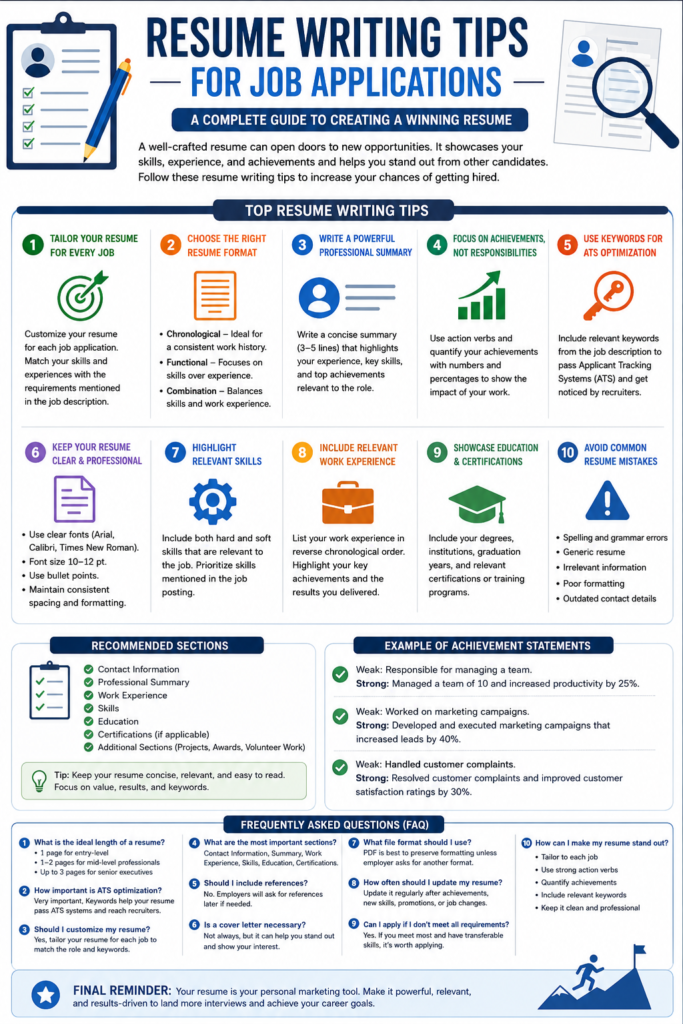
1. Tailor Your Resume for Every Job Application
One of the biggest mistakes job seekers make is sending the same resume to every employer. Recruiters want to see candidates whose qualifications closely match the job requirements.
How to Customize Your Resume
- Carefully read the job description.
- Identify relevant keywords and skills.
- Highlight experiences that align with the position.
- Adjust your professional summary to match the role.
- Prioritize accomplishments related to the employer’s needs.
Customizing your resume demonstrates genuine interest in the position and improves your chances of passing ATS screening systems.
2. Choose the Right Resume Format
Selecting the appropriate resume format can make your information easier to read and understand.
Chronological Resume
This format lists work experience in reverse chronological order and is ideal for candidates with a consistent employment history.
Functional Resume
A skills-based format that focuses on competencies rather than work history. It is suitable for career changers or individuals with employment gaps.
Combination Resume
This format combines elements of both chronological and functional resumes, showcasing skills and work experience equally.
For most job seekers, the chronological format remains the preferred choice because recruiters are familiar with it.
3. Write a Powerful Professional Summary
Your professional summary appears at the top of your resume and acts as your elevator pitch.
Example
“Results-driven marketing specialist with over five years of experience in digital marketing, content strategy, and lead generation. Proven track record of increasing website traffic by 45% and improving conversion rates through data-driven campaigns.”
Tips for Writing a Strong Summary
- Keep it between 3–5 lines.
- Highlight your experience level.
- Mention key skills.
- Include measurable achievements.
- Align it with the target position.
A compelling summary encourages recruiters to continue reading your resume.
4. Focus on Achievements Instead of Responsibilities
Many candidates simply list their job duties. However, employers are more interested in what you accomplished.
Weak Example
- Responsible for managing customer service operations.
Strong Example
- Improved customer satisfaction ratings by 25% through the implementation of a new support system.
Use action verbs such as:
- Achieved
- Increased
- Reduced
- Developed
- Implemented
- Managed
- Optimized
- Generated
Whenever possible, quantify your accomplishments with numbers and percentages.
5. Use Keywords for ATS Optimization
Most companies use Applicant Tracking Systems to filter resumes before they reach human recruiters.
Important Resume Keywords
Keywords may include:
- Project Management
- Data Analysis
- Customer Service
- Digital Marketing
- Leadership
- Problem Solving
- Team Collaboration
- Strategic Planning
Review the job posting and naturally incorporate relevant terms throughout your resume.
SEO Tip for Resumes
Using industry-specific keywords increases your chances of ranking higher within ATS software and improves visibility during recruiter searches.
6. Keep Your Resume Clear and Professional
A clean layout improves readability and creates a professional appearance.
Formatting Best Practices
- Use professional fonts such as Arial, Calibri, or Times New Roman.
- Choose font sizes between 10 and 12 points.
- Maintain consistent spacing.
- Use bullet points instead of large text blocks.
- Keep margins balanced.
- Use bold headings for sections.
Avoid excessive graphics, colors, or decorative elements unless you are applying for a creative role.
7. Highlight Relevant Skills
The skills section should showcase both hard skills and soft skills.
Hard Skills
- Programming
- Data Analysis
- Graphic Design
- Financial Reporting
- SEO Optimization
- Project Management
Soft Skills
- Communication
- Leadership
- Adaptability
- Time Management
- Problem Solving
- Teamwork
Prioritize skills that are specifically mentioned in the job description.
8. Include Relevant Work Experience
The work experience section is often the most important part of a resume.
Recommended Structure
Job Title
Company Name | Employment Dates
- Achievement or responsibility
- Achievement or responsibility
- Achievement or responsibility
Example
Digital Marketing Manager
ABC Company | 2021–Present
- Increased organic website traffic by 60% within one year.
- Managed advertising campaigns with a budget exceeding $100,000.
- Improved lead generation by 35% through SEO and content marketing strategies.
Focus on recent and relevant experience that demonstrates your qualifications.
9. Showcase Education and Certifications
Employers often look for educational qualifications and professional certifications.
Include:
- Degree name
- Institution name
- Graduation year
- Relevant certifications
- Professional training programs
Examples of Valuable Certifications
- Google Analytics Certification
- PMP Certification
- AWS Certified Solutions Architect
- HubSpot Content Marketing Certification
- Microsoft Certified Professional
Certifications can strengthen your profile and demonstrate ongoing professional development.
10. Add a Dedicated Skills and Certifications Section
Creating separate sections for skills and certifications improves organization and makes important information easier to find.
Example
Core Competencies
- Search Engine Optimization (SEO)
- Content Marketing
- Data Analytics
- Customer Relationship Management
- Project Leadership
Certifications
- Google Analytics Certified
- HubSpot Content Marketing Certified
This structure improves readability and ATS compatibility.
11. Avoid Common Resume Mistakes
Even highly qualified candidates can be rejected because of avoidable errors.
Common Mistakes
- Spelling and grammar errors
- Outdated contact information
- Generic objective statements
- Excessive length
- Inconsistent formatting
- Irrelevant work experience
- Keyword stuffing
Always proofread your resume multiple times before submission.
12. Optimize Your Resume for Mobile and Digital Viewing
Many recruiters review applications on mobile devices.
Best Practices
- Save your resume as a PDF unless instructed otherwise.
- Use standard section headings.
- Avoid complex tables and graphics.
- Ensure text remains readable on smaller screens.
A mobile-friendly resume improves accessibility and professionalism.
13. Include a Strong Cover Letter
Although separate from your resume, a cover letter can significantly improve your application.
Effective Cover Letter Elements
- Personalized greeting
- Introduction explaining interest in the role
- Key achievements and qualifications
- Explanation of company fit
- Professional closing
A tailored cover letter reinforces the information presented in your resume.
14. Keep Your Resume Concise
Recruiters prefer concise resumes that communicate value quickly.
Length Guidelines
- Entry-level candidates: 1 page
- Mid-level professionals: 1–2 pages
- Senior executives: Up to 3 pages if necessary
Focus on quality rather than quantity.
15. Proofread Before Submitting
Proofreading is one of the most important final steps.
Review Checklist
✔ Correct spelling and grammar
✔ Consistent formatting
✔ Accurate contact information
✔ Relevant keywords included
✔ Clear achievement statements
✔ Proper file name
Consider asking a colleague, mentor, or professional resume writer to review your document before submission.
Frequently Asked Questions (FAQ) About Resume Writing
1. What is the ideal length of a resume?
The ideal resume length depends on your experience level. Entry-level candidates should typically keep their resume to one page, while professionals with several years of experience can use two pages. Senior executives and specialized professionals may require three pages if they have extensive accomplishments and relevant experience.
2. How important is ATS optimization for a resume?
ATS (Applicant Tracking System) optimization is extremely important because many employers use these systems to screen applications before they reach recruiters. Including relevant keywords from the job description can significantly improve your chances of passing ATS filters and getting noticed by hiring managers.
3. Should I customize my resume for every job application?
Yes. Tailoring your resume for each position increases your chances of success. Customize your professional summary, skills, and work experience to match the specific requirements and keywords mentioned in the job posting.
4. What are the most important sections of a resume?
A professional resume should typically include:
- Contact Information
- Professional Summary
- Work Experience
- Skills
- Education
- Certifications (if applicable)
Depending on your industry, you may also include projects, volunteer experience, awards, or professional memberships.
5. What skills should I include on my resume?
You should include both hard skills and soft skills that are relevant to the position. Examples include:
Hard Skills:
- Data Analysis
- Project Management
- SEO
- Programming
- Graphic Design
Soft Skills:
- Communication
- Leadership
- Teamwork
- Problem Solving
- Time Management
Always prioritize skills mentioned in the job description.
6. Should I include references on my resume?
No. Modern resume writing standards do not require listing references or including the phrase “References Available Upon Request.” Employers will ask for references later in the hiring process if needed.
7. Is a cover letter necessary when applying for jobs?
While not always mandatory, a well-written cover letter can strengthen your application. It provides an opportunity to explain your interest in the role, highlight key achievements, and demonstrate how your experience aligns with the company’s needs.
8. What are the most common resume mistakes to avoid?
Some of the most common resume mistakes include:
- Spelling and grammar errors
- Using a generic resume for every application
- Including irrelevant information
- Failing to quantify achievements
- Poor formatting and readability
- Missing important keywords for ATS systems
- Providing outdated contact information
9. Should I use a resume objective or a professional summary?
A professional summary is generally preferred over a resume objective. A summary focuses on your qualifications, experience, and achievements, while an objective often focuses on what you want from the employer. Recruiters are more interested in the value you can provide.
10. What file format should I use when submitting my resume?
PDF is usually the best format because it preserves formatting across different devices and operating systems. However, always follow the employer’s application instructions if a different format is requested.
11. How often should I update my resume?
You should update your resume regularly, especially after:
- Completing a major project
- Receiving a promotion
- Earning a certification
- Acquiring new skills
- Changing jobs
Keeping your resume current makes it easier to apply for opportunities when they arise.
12. Can I apply for a job if I do not meet all the requirements?
Yes. Many employers expect candidates to meet most, but not necessarily all, of the listed requirements. If you possess the majority of the qualifications and can demonstrate transferable skills, it is often worthwhile to apply.
13. What keywords should I include in my resume?
The best resume keywords are those found in the job description. Common examples include:
- Leadership
- Project Management
- Customer Service
- Strategic Planning
- Digital Marketing
- Data Analysis
- Team Collaboration
- Problem Solving
Using relevant keywords naturally throughout your resume improves ATS compatibility.
14. Should I include volunteer work on my resume?
Yes, especially if the volunteer experience demonstrates valuable skills, leadership, project management, community involvement, or industry-related expertise. Volunteer work can strengthen your profile, particularly for recent graduates or career changers.
15. How can I make my resume stand out from other applicants?
To make your resume stand out:
- Tailor it to each job application.
- Focus on measurable achievements.
- Use strong action verbs.
- Include relevant keywords.
- Maintain a clean and professional format.
- Highlight certifications and specialized skills.
- Showcase results with numbers and percentages whenever possible.
A well-structured, achievement-focused, and ATS-friendly resume is far more likely to attract the attention of recruiters and hiring managers.
Conclusion
Creating an effective resume requires more than simply listing your work history. A successful resume is strategically designed to showcase your achievements, highlight relevant skills, and align with the specific requirements of each job application. By tailoring your resume, optimizing it for ATS systems, using measurable accomplishments, and maintaining a professional format, you can significantly increase your chances of securing interviews.
Remember that your resume is often the first impression an employer has of you. Investing time in creating a polished, keyword-optimized, and achievement-focused resume can make the difference between being overlooked and being invited for an interview. Apply these resume writing tips consistently, and you will be better positioned to stand out in today’s competitive job market and move closer to achieving your career goals.
SEO Keywords Included: Resume Writing Tips, Job Applications, Professional Resume, ATS Resume, Resume Format, Resume Writing Guide, Resume Optimization, Job Search Tips, Career Development, Resume Keywords, Professional Summary, Resume Skills, Work Experience, Resume for Jobs, Resume Best Practices.